


Why Your Neck Could Be Causing Headaches, Jaw Pain, and Dizziness


I hear the below statements at least weekly from both new patients and chatting with people within my own community.
“My headaches come and go, but they won’t go away.”
“My jaw keeps clicking and hurting.”
“I feel dizzy but my scans are normal…and they checked the crystals, and they are normal”
“I even get tingling in my face sometimes, but that’s not anything related, right?”.
“When the headaches are bad, sometimes my ears ring.”
Or sometimes a patient is simply chatting about their headaches and few surface level questions reveal that they experience any combination of jaw pain, tinnitus, and dizziness during headaches flare ups.
And almost every time, there is one common thread that has either been overlooked or never thoroughly addressed.
The neck. More importantly, the upper neck…
And more specifically, a structure within the upper neck called the trigemino-cervical nucleus (Can be called the cervico-trigeminal nucleus - which I typically go with)!
What Is the Cervico-Trigeminal Nucleus?
Don’t worry, this is where most explanations get way too technical and deep in the weeds. I will try to keep this simple.
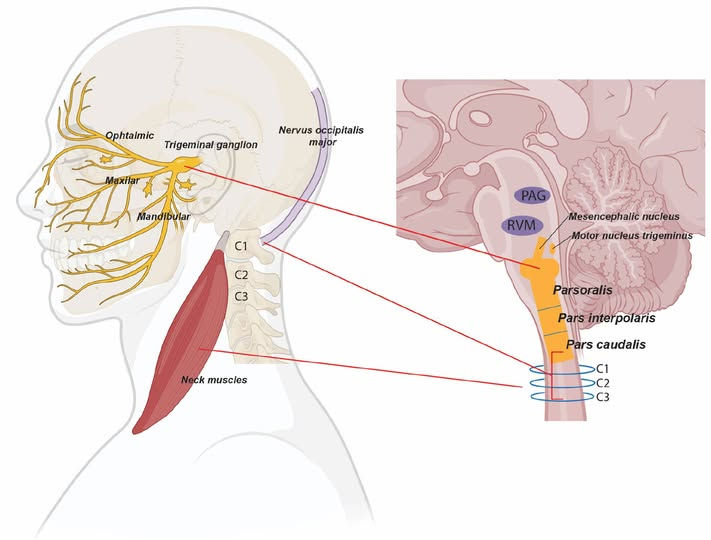
The cervico-trigeminal nucleus is a region in your brainstem where nerves from your neck and nerves from your face/jaw meet and share information.
In other words, and using one of my trademarked analogies / oversimplified visuals…
I imagine there is a little post office (nucleus) in the upper neck where signals from the neck and trigeminal nerve come in, are sorted by the workers, and sent on their way to the proper destination.
Only when there is dysfunction or issue present, the postal workers get very confused about where the signals are coming from and definitely where to send the message.
So instead of clearly saying: “This is coming from your neck,” it might feel like a headache, jaw pain, facial tingling, ear ringing, dizziness, or headaches.
Why This Matters for Your Symptoms
This shared pathway is the reason why you can have headaches that don’t respond to typical treatments (migraine medication, for example), TMJ pain that keeps coming back (it was never a bite problem), dizziness with normal imaging (because it wasn’t a brain or crystal problem), facial symptoms with no clear dental or neurological cause.
Because traditional, fast-paced healthcare will focus on the puddle (symptoms) and not go deep enough to assess the leaky pipe (root cause) above the puddle. Simply put, the source of the problem might not be where you feel it.
Common Conditions Linked to This Connection
When this system is irritated or overloaded, it can contribute to:
cervicogenic headaches (headaches coming from the neck), cervicogenic dizziness (dizziness coming from the neck), TMJ dysfunction, jaw pain and clicking, facial tingling or numbness.
And almost always, there is a history of:
Neck stiffness, previous neck injury, poor posture or prolonged sitting, repetitive strain on the neck.
Why This Often Gets Missed
Let’s be honest … this is simply not commonly discussed. Many providers are trained to look at symptoms in isolation, or have a line of patients out of the door so they are treating the complaint as fast as possible.
Or the training of a particular provider simply leads to dismissal of the Cervico-Trigeminal Nucleus/Upper Neck playing a large role in their patient’s symptoms.
It’s not as black and white as:
Headaches → medication or neurology
Jaw pain → dental or TMJ-specific care
Dizziness → vestibular system
Tinnitus → neurology or audiology
Sure, those are all valid considerations. But if the neck is never even assessed, a major piece of the puzzle can be missed.
And to make sure I say this too, if the neck is thoroughly assessed and there are no signs or indicators that your headaches (or above reports) are stemming from the neck, then of course other root causes need to be assessed.
While it’s not always the cervico-trigeminal nucleus, it is always initially overlooked.
And when that happens, people end up stuck in cycles of temporary relief without long-term change.
The Problem with Treating the Wrong Area
If your upper neck is driving the problem, but treatment is focused elsewhere…
…you will likely experience short-term relief, symptoms that keep coming back, increasing frustration, and more providers, more opinions, without a clear answer.
This is very similar to what we see with low back pain. Without a clear diagnosis, treatment becomes generalized and guesswork.
What Does the Right Treatment Look Like?
Here’s the crux of this story - The key is not just knowing this structure exists.
The key is identifying if it is actually contributing to your symptoms.
At Flow Physical Therapy and Wellness, this starts with a detailed, one-on-one assessment with a differential diagnosis to determine…
Is your neck contributing to your headaches or jaw pain? Are your symptoms reproducible with neck movement? Is there stiffness or dysfunction in specific cervical segments?
And sometimes, an undervalued part of healthcare is as simple as allowing you to tell me a detailed account of your symptoms, without you feeling rushed…
Will you unknowingly lead me to the cervico-trigeminal nucleus by organically saying the following, “well I’ve neck pain that comes and goes from a car accident years ago” paired with “sometimes I have ringing in my ear when I sit at the computer too long” and “sorry if I stretch my jaw, it bothers me when I talk a lot,” combined with your presenting diagnosis of “migraine” that isn’t resolving with migraine medication.
Listening to you is the most valuable tool in healthcare - after all, no one knows how you feel and experience your symptoms better than you.
From there, treatment is tailored to you.
How We Treat These Symptoms
When the neck is involved, treatment often includes a combination of manual therapy (hands-on techniques) to improve joint mobility and reduce irritation, dry needling to specific targets at the upper neck, corrective strengthening to improve neck and postural support, movement retraining to reduce recurring stress and improve biomechanics.
And importantly, we are not just treating symptoms - we are addressing the underlying driver.
Why a Holistic Approach Matters
There are many perceptions and interpretations to the word “Holistic.” When I say I treat holistically, I define Holistic Physical Therapy as:
You cannot treat this area effectively by only focusing on one region or without considering other systems within the body (upregulated nervous system, biomechanics dysfunction within the musculoskeletal system, and maybe increased cortisol due to stress or dietary issues, as an example).
The neck, jaw, and nervous system are all connected.
This is why a more holistic, full-body approach is necessary, especially when symptoms are complex or have been lingering for months or years.
Does This Sound Like You?
If you are tired of dealing with any one or combination of headaches, jaw pain, ringing in the ear, dizziness, facial tingling, and neck pain, then the cervico-trigeminal nucleus may be the missing link that connects all of your symptoms.
Ready to Finally Get Answers?
You do not need to keep bouncing between providers that specialize in one of the puddles (symptoms). And you definitely don’t need to be guessing at solutions.
If you are in Lafayette, Youngsville, Broussard, or the surrounding Acadiana area, you have access to one-on-one, 60-minute Osteopractic Physical Therapy sessions at Flow Physical Therapy and Wellness.
At Flow Physical Therapy, you will find a clear understanding of what is driving your symptoms and a plan to fix it.
Dr. Patrick Thompson, PT, DPT, OCS, Dip. Osteopractic, FAAOMPT
Owner of Flow Physical Therapy and Wellness
337-366-1703


Comments